


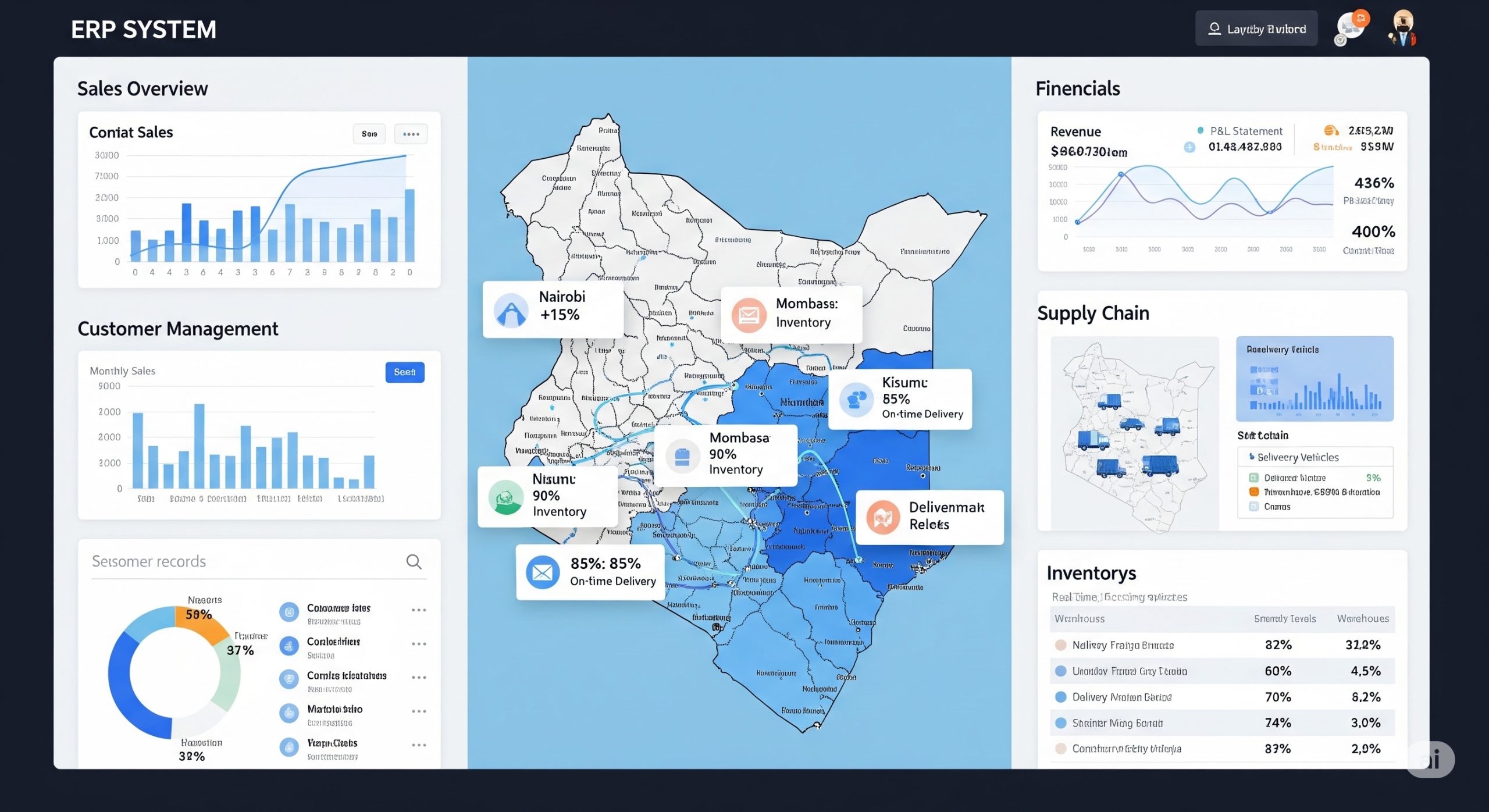
Across Kenya and much of Africa, small and medium enterprises (SMEs) are the economy’s backbone whether stalls, small factories, transport operators, guesthouses, and digital startups. Yet when it comes to enterprise resource planning (ERP) systems and cloud software-as-a-service (SaaS) tools that could streamline finance, inventory, payroll and sales, many business owners shrug, stick to their Excel sheets and cash books, or lean on manual routines that are slow, error-prone and opaque. On paper, ERPs and SaaS reduce operational leakages, automate reconciliation, and make reporting simpler. In practice, uptake is patchy. Why?
Below we unpack the real reasons be it economic, cultural and infrastructural, and show what the research says, and end with practical steps to bridge the gap.

1. The subscription model feels like a cost, not an investment
The single biggest psychological and financial barrier is the recurring fee. Traditional capital costs (buy once) feel more “owned” than ongoing subscriptions that subtract from monthly revenue. For many small business owners, the subscription is visible and immediate — a line on the bank statement — while the benefits (fewer errors, time saved) are diffuse and long-term. Research reviews show that concerns about initial and ongoing costs are a top barrier to cloud and ERP adoption among SMEs.
Practical reality: an owner who pays KES 8,000/month for an inventory + POS SaaS will see that as KES 96,000 a year — money they would rather keep in working capital than move to a software vendor whose ROI feels uncertain.
2. Cost doesn’t always translate directly to revenue — so managers view it as deduction
Most small businesses measure success in immediate terms: daily sales, weekly cashflow, and month-end profits. When a subscription reduces net revenue on paper, managers often conclude it’s eating profit. Because improved accuracy or reduced shrinkage is incremental and hard to assign to a single month’s sales uplift, the math rarely convinces a cash-constrained entrepreneur — even if the longer-term bottom line would improve.
Studies of cloud adoption consistently find that SMEs rate perceived economic benefits ambiguously, and worry that cost savings from moving to SaaS won’t materialize fast enough.
3. Weak digital foundations and hidden extra costs
An ERP or cloud solution assumes basic prerequisites: stable internet, reliable power, staff who can use the system, and sometimes local integrations (bank feeds, tax systems). Where those are missing, adoption requires additional spending: better connectivity, training, devices, or bespoke integration work. Those add-on costs make the initial subscription just the tip of the iceberg.
World Bank and GSMA analyses of African digitalisation highlight that without foundational investments — digital skills, connectivity and supportive policy — digital technologies deliver less value and face slower uptake.

4. Skills gaps — the “we’ll just ask cousin to handle Excel” problem
SMEs frequently lack internal IT skills or management bandwidth to implement and maintain new software. Hiring or training staff is an added expense, and outsourcing implementation to vendors raises trust and cost concerns. Even when solutions are designed for non-technical users, the shift to new processes (how to record inventory, code expenses, manage users) requires time and structured onboarding — something many small businesses can’t spare.
A systematic review of cloud computing impacts on SMEs shows management support and digital skills are among the strongest predictors of successful adoption; without them, perceived risk and complexity increase.
5. Trust, Data Security, and Fear of Government Surveillance
In Kenya, ERPs are often required to integrate with government tax systems—like eTIMS or iTax—to generate e-invoices or submit real-time VAT data. However, this naturally triggers deep paranoia:
- KRA’s digital surveillance infrastructure already links systems like iTax, IFMIS, GHRIS, and the Central Bank for near real-time oversight.
- The new systems expose invoices, supplier payments, and turnover immediately to KRA. Even cashless transactions are flagged.
- Public discourse labels this digital sweep as intrusive—commenters voice concerns that financial surveillance sets Kenya on a path toward a surveillance state.
So SMEs fear that these systems make them visible—and vulnerable—not just to tax inspectors, but potentially political scrutiny.

6. Hidden cultural & organizational inertia: if it’s not broken, don’t fix it
Many small businesses are risk-averse by necessity. Owners hold mental models that equate change with disruption. If cashiers, store managers, and suppliers have “always” operated a certain way, convincing everyone to change process is as political as it is technical. Loss aversion plays a role: the fear of losing the known is stronger than the promise of a potential gain.
A scoping review on digital transformation in sub-Saharan Africa finds that organizational readiness and change management are recurring weak links.
7. Fragmented value proposition from vendors — one size doesn’t fit all
Many global ERP/SaaS vendors present packaged products designed for larger or more developed markets. In African SME contexts, vendors often fail to localize pricing, UX, language, tax rules, and payment collection methods. Where software doesn’t map to local workflows (e.g., cash-based transactions, informal credit, local tax idiosyncrasies), the fit is poor and adoption stalls.
Studies of ERP implementations in developing countries stress that context-aware customization and phased rollouts are essential to reduce failure rates.
8. Evidence — what the studies say (quick summary)
- Systematic reviews of cloud computing show cost concerns and perceived risks are among top barriers; management support and service quality are strong drivers of success.
- Papers examining ERP in developing and African contexts document high implementation failure rates when projects ignore local constraints, and note lack of local vendor ecosystems as a problem.
- GSMA and World Bank digital reports emphasise that connectivity, skills, and policy foundations are crucial for SMEs to benefit from digital tech.
9. A pinch of humor: business owners vs the SaaS pitch
Think of SaaS like a gym membership. You pay monthly and the potential to get fit is huge, but if you still eat chips while watching football, the subscription won’t show up in your waistline. For many SMEs, the “gym” is appealing, but juggling customers, stock, rent, and family means the treadmill sits unused — then the owner cancels the plan and goes back to lifting crates by hand. Change is the workout — and the coach (vendor) must be convincing.
10. Practical solutions — how to make adoption realistic and attractive
- Show immediate, measurable wins.
Vendors and consultants should focus on quick-win modules (e.g., cashbook + POS reconciliation) that pay for themselves in 1–3 months through reduced shrinkage or faster invoicing. - Offer flexible pricing & micro-subscriptions.
Daily/weekly billing options, pay-as-you-grow modules, and bundled training reduce perceived risk and make subscriptions feel less like permanent deductions. - Phased rollouts with local onboarding.
Start with one outlet or function, measure impact, then scale. Local implementation partners build trust and keep costs sensible. - Invest in foundational digital readiness.
Governments and development partners should subsidize business training, provide affordable connectivity, and support vendor accreditation to lower vendor risk. - Transparent exit & data portability policies.
Contracts that guarantee data export, readily accessible backups, and clear SLAs reduce lock-in fears. - Demonstrate ROI in revenue and cost terms.
Present case studies that show increases in invoice collection rate, reduced stockouts, or time saved on reconciliation, expressed in local currency and months-to-payback.
11. Call to action (for policymakers, vendors & SMEs)
- Policymakers: subsidize SME training and digital infrastructure, and promote standards for data portability.
- Vendors: localize offerings, design micro-pricing, and publish plain-language SLAs.
- SME owners: start small, pick a champion in your team, and measure one metric (time saved, errors reduced, or cash collected) in 90 days.
Kenyan and African small businesses are not “anti-technology” — they are practical. Faced with tight cashflows, weak infrastructure, and the visible pain of a recurring subscription, many rationally delay ERP and SaaS adoption. To shift the balance, vendors and policymakers must make the first steps low-risk, demonstrably valuable and locally relevant. When the subscription feels like a tool that pays for itself within months rather than a mysterious monthly pill, adoption will follow.






Leave a Reply